

Everest Base Camp Trek Permit and Insurance Guide
Cost, Types & Where to Get Them
Every trekker who has spent a few hours researching the Everest Base Camp trek runs into the same wall of conflicting information. One blog says you need three permits. Another says two. A third still mentions a TIMS card that was scrapped years ago. Somewhere in the middle of all that, insurance gets mentioned as an afterthought, when in reality it is just as important as any government permit, arguably more so once you are above Namche and something actually goes wrong.
Here is the short version: as of 2026, you need exactly two government permits to trek to Everest Base Camp, and you need one solid insurance policy that covers high-altitude trekking and helicopter evacuation. That is the complete list. No TIMS card, no third permit, no guesswork. This guide walks through both permits and the insurance question in full detail, what everything costs, where and how to sort it, what happens if you skip any of it, and how requirements shift across route variations, whether you are booked on the standard trek, a budget itinerary, or something longer like a high pass crossing.
Before you get into the permit details, it helps to know what shape your trek will actually take. Our Everest Base Camp Trek Itinerary guide lays out day-by-day plans for every version of this route, so you know exactly which checkpoints and villages you will be passing through.
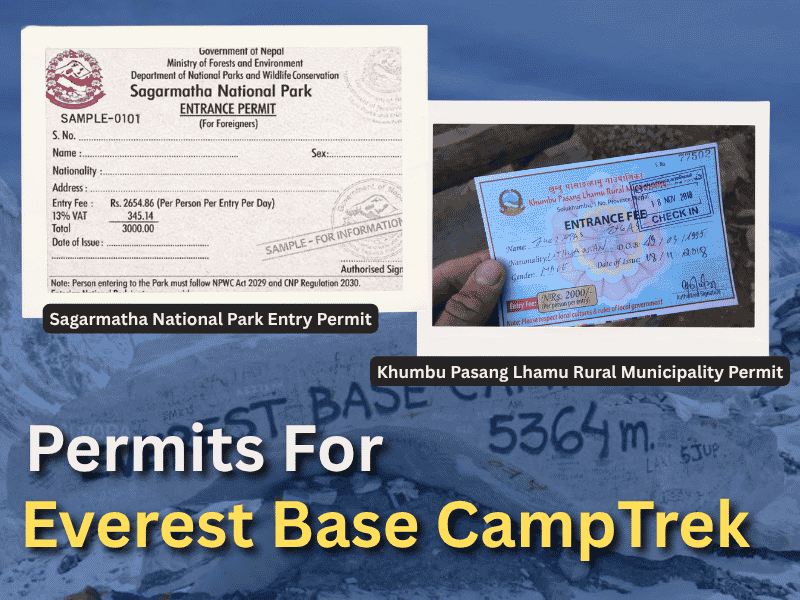
Quick Glance: What You Actually Need
If you only read one section of this guide, read this one.
- Sagarmatha National Park Entry Permit: required for everyone entering the park
- Khumbu Pasang Lhamu Rural Municipality Permit: required for everyone entering the Khumbu region
- Total permit cost for foreign nationals: approximately $37 to $45 USD per person
- TIMS card: not required for this region since October 2018
- Gaurishankar Conservation Area Permit: only needed if you start from Jiri or Salleri instead of flying into Lukla
- Travel insurance with high-altitude and helicopter evacuation cover: not a government-stamped permit, but every reputable agency will require it, and you genuinely do not want to be on this trail without it
That covers the standard Everest Base Camp Trek route. If you are doing a longer variation, the permits and insurance requirement stay the same since every route into the Khumbu passes through the same park and municipality boundaries.
Why do I need Permits ?
- Sagarmatha National Park covers over 1,148 sq km of the Khumbu, a UNESCO World Heritage Site home to snow leopards, red pandas, and untouched alpine forest
- Park permit fees fund conservation, trail maintenance, and wildlife protection
- Municipality permit fees fund local infrastructure you actually use, things like trail bridges, waste management, and emergency services
- These aren’t arbitrary tourist taxes, they’re checked at multiple points because they fund things that directly affect your safety on the trail
- Nepal’s treks fall into three permit categories: national parks, conservation areas, and restricted areas, each with its own fee structure
- Sagarmatha sits in the simplest, cheapest tier. Restricted areas like Upper Mustang or Kanchenjunga require pricier daily-fee permits
- Despite being the world’s most famous trek, EBC actually has one of Nepal’s simplest permit systems
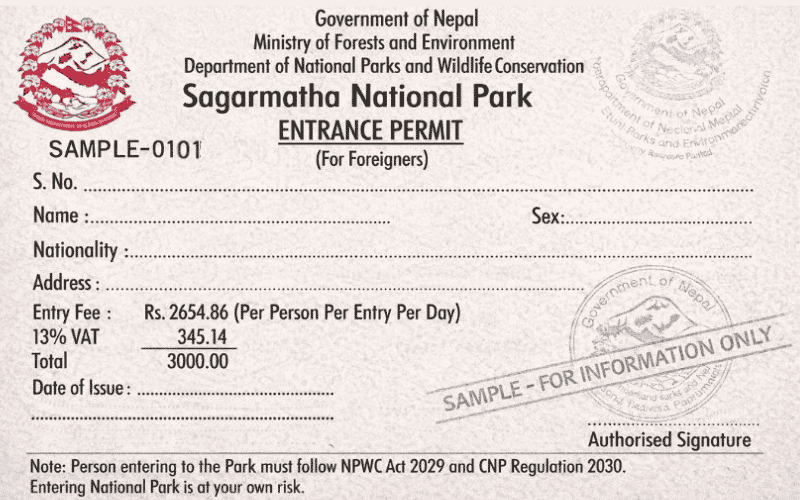
Permit One: Sagarmatha National Park Entry Permit
This is the permit that gets you into the park itself. Every single person walking toward Everest Base Camp, regardless of nationality, needs this.
Cost Breakdown by Nationality
| Nationality | Cost |
| Foreign nationals (non-SAARC) | NPR 3,000 (~$22-23 USD) |
| SAARC nationals | NPR 1,500 (~$11 USD) |
| Nepali citizens | NPR 100 |
Prices are set in Nepali Rupees and can shift slightly with exchange rate fluctuations, so treat the USD figures as approximate. Always budget a little extra rather than arriving with the exact amount.
Where to Get It
You have two options, and both are equally valid, though only one of them means you never have to think about this again.
- Nepal Tourism Board Office, Kathmandu: Located at Bhrikutimandap in Kathmandu, this is the most convenient option if you want everything sorted before you fly to Lukla. Processing is usually quick if you arrive with the right documents, and getting it done in Kathmandu means one less thing to think about once you are on the trail.
- Monjo Entry Gate: If you did not get it in Kathmandu, you can buy it at the park entrance in Monjo, which you will pass through naturally on your second day of trekking, between Phakding and Namche Bazaar. There is a checkpoint here specifically for this purpose, and the rangers are used to processing trekkers daily during peak season.
Or, skip both and let us handle it: This is exactly the kind of small but easy-to-mess-up logistics that our team at Nepal Mountain Adventure takes off your plate the moment you book with us. Every one of our EBC packages includes both permits, arranged and paid for before you even land in Kathmandu, so there’s no queue, no paperwork, and no wondering whether you brought the right documents. If you’d rather spend that admin time actually planning the fun parts of your trip, get in touch with our team and we’ll take it from there.
What You Need to Bring
- A valid passport
- Two passport-sized photographs
- Cash in Nepali Rupees (USD is sometimes accepted but do not rely on it)
This is a good moment to also double check the rest of your kit is sorted, since Kathmandu is a far easier place to pick up a forgotten item than Namche. Our Everest Base Camp Trek Packing List covers exactly what to bring and what is easy to rent locally instead.
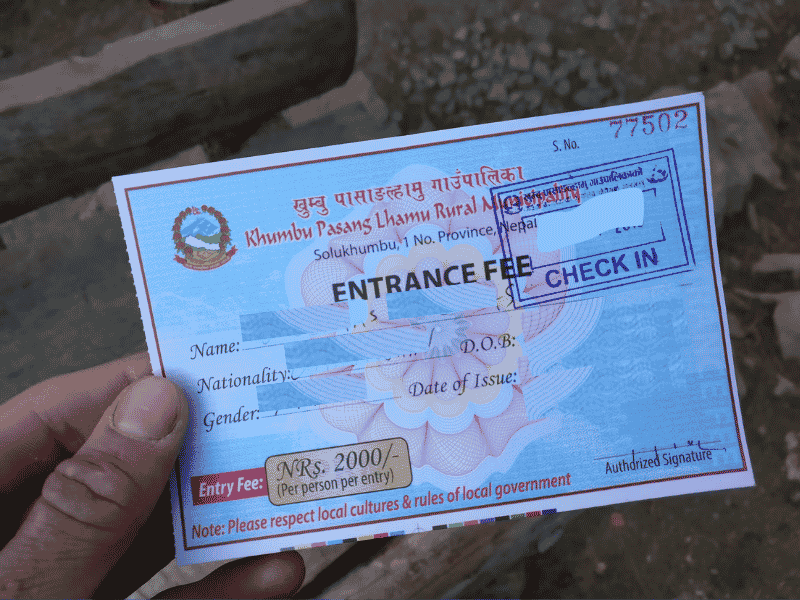
Permit Two: Khumbu Pasang Lhamu Rural Municipality Permit
This is the permit that trips people up the most, mainly because it cannot be obtained in Kathmandu. This one is local, and local means local.
Cost Breakdown
| Nationality | Cost |
| Foreign nationals | NPR 2,000-3,000 (~$15-23 USD) |
| SAARC nationals | NPR 2,000-3,000 (~$15-23 USD) |
| Nepali citizens | Free |
Because this permit is administered locally rather than nationally, it is adjusted more often than the park fee, and the exact figure can shift from one trekking season to the next. Your guide or agency will always know the current rate, and the amount is clearly posted at the Lukla counter regardless.
Where to Get It ?
Unlike the Sagarmatha permit, this one is only available in Lukla, if you are following the standard route of flying in from Kathmandu. The permit counter is right near where you land, and if you are on a guided trek, your guide will handle this the moment you arrive. If you have not flown into Lukla before, it is worth reading up on what the flight itself involves, our Kathmandu to Lukla Flight Guide covers timing, delays, and what to expect on the world’s most talked-about short flight.
If you are following the classic overland route starting from Jiri or Salleri rather than flying, you obtain this permit at the first village you enter within the Khumbu boundary instead of Lukla.
This permit replaced what used to be a separate requirement and now functions as the sole local entry document for the region. It exists specifically to give the local municipality a way to track visitor numbers and fund community projects that the national park fee does not cover, things like local schools, health posts, and municipal infrastructure in villages like Namche and Khumjung. This is one of the more commonly missed details for independent trekkers with Nepal Mountain Adventure, our guide takes care of this the moment you land, so it’s simply done before you’ve even picked up your duffel.
The Permit You No Longer Need: TIMS Card
If you read older blog posts, guidebooks from before 2019, or even some trekking company websites that have not updated their content, you will see repeated mentions of a TIMS card, the Trekkers’ Information Management System.
This was a real requirement until October 2018. It cost independent trekkers around $20 and group trekkers around $10. It was designed to help track trekkers for safety purposes, similar in spirit to the municipality permit that exists now.
As of October 2018, the TIMS requirement was dropped for the Khumbu and Everest Base Camp region specifically. The municipality permit above absorbed that tracking function. If someone tries to sell you a TIMS card for this specific route in 2026, that is outdated information at best, or a scam at worst. TIMS is still required for some other trekking regions in Nepal, which is why the confusion persists, but not for Everest Base Camp.
TIMS existed partly as a safety measure, and safety is worth taking seriously here regardless of paperwork. If you are still weighing how physically demanding this trek actually is before you commit to it, our Everest Base Camp Trek Difficulty guide gives an honest breakdown.
The Permit You Only Need for the Classic Route: Gaurishankar Conservation Area Permit
If you’re flying directly into Lukla like most trekkers this one is conditional, you can skip it entirely.
If you’re doing the classic overland route from Jiri or Salleri instead, the trail passes through the Gaurishankar Conservation Area before reaching the Khumbu boundary, requiring its own separate permit, obtainable in Kathmandu beforehand.
This route adds five to eight extra trekking days through lower altitude hills and traditional villages, a completely different experience from flying in. It was, in fact, the original route to Everest before Lukla’s airstrip existed, walked by Hillary and Tenzing’s era of expeditions. Our Everest Base Camp Trek From Salleri itinerary is built around this slower, more remote start.
The permit itself costs a modest fee for foreign nationals and is processed alongside your other paperwork through an agency. Since this route sees far less traffic than Lukla flights, permit counters here are rarely crowded.
Permit Requirements for Route Variations
Every route through the Khumbu, whether the standard out-and-back, a Gokyo loop, or a high pass crossing, passes through the same national park and municipality boundary. Only your itinerary and duration change, not the permits.
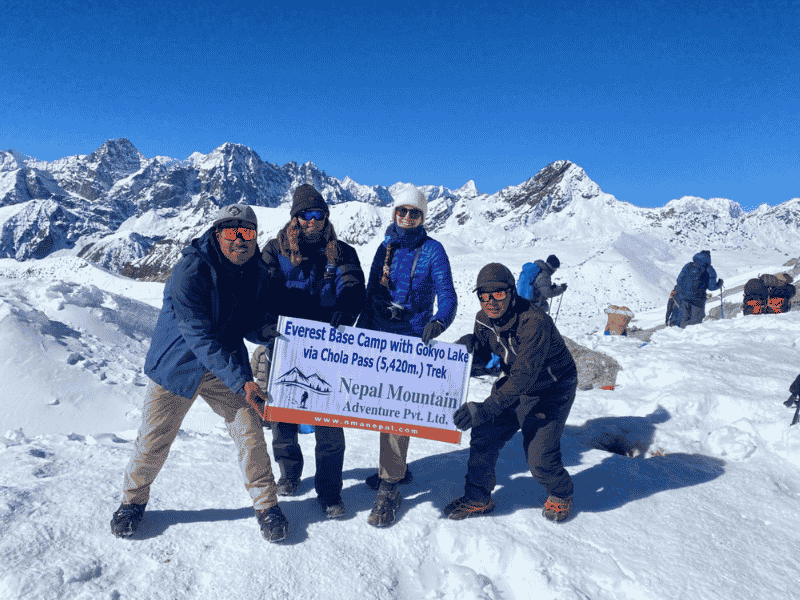
- Everest Base Camp with Gokyo Lake via Chola Pass: same two permits, despite the extra distance and glacier crossing. See the full Everest Base Camp With Gokyo Lake Via Chola Pass package.
- Everest Three High Pass Trek: same two permits, even with Kongma La and Renjo La added. Details on the Everest Three High Pass Trek page.
- Everest Base Camp Budget Trek, 12 Days: same two permits, just a faster itinerary. See the Everest Base Camp Budget Trek-12 Days.
- Everest Base Camp Luxury Trek: same permits, better comfort. Money buys comfort here, not different paperwork. See the Everest Base Camp Luxury Trek.
Distance and daily walking hours are what actually change between routes, not the paperwork. Our Everest Base Camp Trek Distance guide breaks down how far each version covers.
How Permits Are Checked on the Trail
You will not just buy these permits and forget about them. Checkpoints exist at several points along the route, and rangers or municipality staff will ask to see your physical permit card. The most common checkpoints are:
- The park entrance gate at Monjo
- A secondary check near Namche Bazaar
- Occasional spot checks further up the trail during peak season
Keep both permit cards somewhere accessible, not buried at the bottom of your duffel bag that your porter is carrying two hours ahead of you. A small dry bag or document pouch in your daypack works well, since these are physical paper cards, not digital passes, and they should be kept away from rain or sweat. Checkpoint queues do get noticeably longer during the peak spring and autumn crowds, one more small factor worth weighing when you are deciding when to go, alongside the weather and visibility details in our Everest Base Camp Trek Best Time guide.
What If You Lose Your Permit Mid-Trek?
It happens more often than people expect, cards get soaked in unexpected rain, slip out of a pocket at a windy pass, or simply get misplaced in the shuffle of packing and unpacking a duffel every morning. If this happens to you, do not panic and do not try to sneak past a checkpoint hoping nobody notices, rangers check thoroughly and the consequences of getting caught without one are far more disruptive than the inconvenience of replacing it.
The most reliable fix is to report it to your guide immediately if you are on a guided trek, since agencies keep a record of your permit details and can usually arrange a replacement or a confirmation letter faster than an independent trekker could on their own. This is one of the quieter advantages of trekking with an experienced local team, when something goes wrong on the trail, you are not solving it alone at 4,000 meters. If you are managing your own permits, keeping a photo of both permit cards on your phone as a backup, along with a photocopy of your passport, makes the replacement conversation with rangers considerably smoother, even though the physical card itself will still need reissuing at the nearest appropriate office.
What Happens If You Do Not Have a Permit?
This is not a gray area. You cannot proceed past the checkpoints without valid permits. Rangers at Monjo will not let you continue into the park, and this has happened to unprepared independent trekkers who assumed they could sort it out later on the trail. There is no “later” here, the checkpoint is the checkpoint.
If you arrive without one, you will need to either purchase it on the spot if the checkpoint allows it, or in rare cases turn back to the nearest point where it can be issued, which wastes a day you almost certainly do not want to lose on a tightly scheduled trek. This is one of the most avoidable mistakes on the entire trek, and it is entirely preventable with about fifteen minutes of preparation before you leave Kathmandu.
Who Handles Permits in Independent Trekking vs Guided Trek ?
Since August 2023, Nepal introduced new rules requiring solo trekkers to have a licensed guide for treks in most regions, including the Khumbu. This changed the independent trekking landscape significantly and it directly affects how permits are handled.
- If you are trekking with a guide or through an agency, your guide or the agency will handle both permits as part of the standard service. You typically will not need to visit the Nepal Tourism Board office yourself, and your guide will take care of the municipality permit the moment you land in Lukla. This is one of the practical advantages of going guided beyond just safety and navigation.
- If you are technically trekking independently, you will still need a licensed guide under current regulations, but you retain more control over your own logistics, including potentially handling your own permit purchases in Kathmandu before meeting your guide. Confirm with whoever you are working with exactly who is responsible for which document before your trek begins, so nothing falls through the cracks.
This permit process alone is a small preview of the dozens of little logistics a good local agency absorbs on your behalf. If you are weighing whether to go independent or guided, our Everest Base Camp Trek Guide vs Independent guide breaks down the real cost and safety trade-offs of each.
Whichever way you go, showing up in reasonable shape matters more than which permit desk you visit. Our Everest Base Camp Trek Training Guide covers how to physically prepare in the weeks before you fly.
What Your Insurance Policy Actually Needs to Cover ?
Not every travel insurance policy is built for this. A standard trip-cancellation policy you would buy for a beach holiday will not cover a helicopter rescue from 5,000 meters, and discovering that gap after an emergency has already started is the worst possible time to learn it. Here is what to actually look for.
- Emergency Medical Evacuation Coverage
This is the coverage that matters most for EBC specifically. It pays for medically necessary evacuation, almost always by helicopter, to a hospital in Kathmandu. Make sure the policy explicitly states coverage up to at least 6,000 meters, not just a vague “high altitude trekking” label, since Kala Patthar sits at roughly 5,644 meters and Everest Base Camp itself is around 5,364 meters. Some cheaper policies quietly cap coverage at 4,000 or 5,000 meters, which would leave you exposed for the exact stretch of trail where you are most likely to need it.
- Travel Medical Insurance
This covers the cost of treatment itself if you get sick or injured, separate from the evacuation flight. It typically also includes access to a assistance line that can help locate English-speaking doctors, hospitals, and clinics, which matters more than people expect when you are unwell in an unfamiliar place.
- Trip Cancellation and Interruption Coverage
Lukla flights are notoriously weather-dependent, and delays or cancellations of a day or more are common, not rare exceptions. A policy with trip interruption coverage can reimburse costs if bad weather forces you to cut the trek short or miss connecting flights home.
- Accidental Death and Dismemberment Coverage
Less pleasant to think about, but standard in most solid trekking policies. This pays a benefit to your family in the rare event of a fatal accident or serious permanent injury on the trail.
- Cost Benchmark for a Suitable Policy
For a two to three week Everest Base Camp itinerary, a policy with proper high-altitude and helicopter evacuation coverage typically runs somewhere in the range of $80 to $300, depending on your home country, age, trip length, and the insurer. Compared to a $5,000 to $10,000 evacuation bill paid out of pocket, this is one of the smallest expenses in your entire trek budget for the amount of protection it buys.
Where to Get Travel Insurance for Everest Base Camp ?
Unlike your permits, insurance is not something you pick up in Kathmandu or Lukla. It needs to be arranged before you leave home, since a policy purchased after you are already on the trail, or after symptoms of altitude sickness have already started, will typically not be honored.
A few practical pointers when shopping for a policy:
- Search specifically for “trekking insurance” or “high-altitude insurance” rather than generic travel insurance, since most standard policies exclude activities above 3,000 to 4,000 meters by default
- Read the altitude cap in the policy wording itself, not just the marketing page, insurers sometimes advertise “mountain sports coverage” while capping actual evacuation cover well below what EBC requires
- Confirm the policy covers helicopter evacuation specifically, not just ground ambulance transport, since ground transport is not physically possible from most of this trail
- Buy it as soon as you book your trip, not the week before departure, since some trip cancellation benefits only apply to cancellations that happen after your policy is already in effect
If you would rather not navigate policy wording and altitude clauses on your own, this is exactly the kind of question our team is happy to walk you through before you commit to a plan. Contact the Nepal Mountain Adventure team and we can point you toward the kind of coverage that actually holds up for this specific trek, and help with everything else on your checklist while we are at it.
What Happens If You Trek Without Proper Insurance ?
If you never need a rescue, nothing happens, you simply spent a small amount of money you did not end up using, the same as any insurance. The risk only shows up the moment something goes wrong, and at that point there is no negotiating. Rescue coordinators and helicopter operators in the Khumbu will ask for proof of insurance or a guaranteed payment method before a helicopter leaves the ground. Without it, families have been asked to wire thousands of dollars in real time while a trekker waits at altitude, or the trekker has been left to descend on foot in a condition where descending on foot was not really a safe option.
This is the one part of trip planning where cutting corners does not save money, it just moves the entire financial and medical risk onto you and the people who care about you, at the worst possible moment to be figuring it out.
Staying healthy enough to never need that call in the first place comes down to some fairly ordinary daily habits on the trail, eating enough, staying hydrated, and sleeping somewhere decent. Our Everest Base Camp Trek Food & Water Guide and Everest Base Camp Tea Houses & Accommodation guide cover exactly what to expect on both fronts.
How Much of Your Budget Is Permit and Insurance?
Between the two permits and a solid insurance policy, you are looking at roughly $120 to $350 USD total, depending on your nationality and the specific policy you choose. Against the full cost of an Everest Base Camp trek, including flights, guides, porters, accommodation, and gear, this represents a genuinely small fraction of your overall budget for the amount of legal clearance and financial protection it buys you.
For a complete breakdown of where your money actually goes on this trek, from teahouse costs to guide fees to the Lukla flight itself, our dedicated Everest Base Camp Trek Cost guide covers every expense category in detail.
Ready to Trek?
Between two straightforward permits and one properly chosen insurance policy, everything you need to legally and safely reach Everest Base Camp comes together for well under $400 total, and almost none of it requires more than an afternoon of preparation before you fly. The permits confirm you are allowed on the trail. The insurance makes sure that if anything goes wrong on it, the outcome is a helicopter ride and a hospital bed, not a financial crisis on top of a medical one.
If any part of this, the permits, the insurance shopping, or the trip planning around it, is something you would rather not manage yourself, contact the Nepal Mountain Adventure team. We handle both permits, insurance guidance, the Lukla flight, and your guide on every one of our Everest packages, so all that is left for you to do is walk.
Frequently Asked Questions
Do children need permits for the Everest Base Camp trek?
Yes, permit requirements apply to all trekkers entering the park and municipality boundary regardless of age. There is no exemption for minors, though some family-specific service arrangements may apply through your trekking agency.
Can I get both permits in Kathmandu?
No. The Sagarmatha National Park permit can be obtained in Kathmandu, but the Khumbu Pasang Lhamu Rural Municipality permit is only available in Lukla, or at your first entry point if walking in from Jiri or Salleri.
Do permit prices change seasonally?
Base fees are generally stable throughout the year, but always confirm current rates before departure since municipal fees in particular can be adjusted with limited public notice.
What currency should I bring for permits?
Nepali Rupees are the standard and safest option. While some checkpoints may informally accept USD, do not count on this, and exchanging money in Kathmandu before you fly out is a simple extra step.
Is the TIMS card required for any part of the Everest region?
No, not since October 2018 for the Khumbu and Everest Base Camp area specifically. It remains a requirement in some other trekking regions of Nepal, which is the main source of ongoing confusion online.
Do I need a permit for a day hike near Lukla or Namche that does not reach Base Camp?
If you are entering Sagarmatha National Park at all, even for a shorter hike, the park permit is still required. The municipality permit follows the same rule for the Khumbu boundary.
Is travel insurance legally required to trek to Everest Base Camp?
It is not currently a government-stamped permit checked at park gates the way your Sagarmatha and municipality permits are, but nearly every trekking agency will require proof of insurance with high-altitude and helicopter evacuation coverage before letting you join a guided trek, which makes it a practical requirement even where it is not a legal one.
How much does a helicopter evacuation from Everest Base Camp actually cost?
Typically between $4,000 and $10,000 depending on your altitude, the weather conditions, and how quickly authorization is processed, with costs climbing further if an onward transfer abroad is needed.
Can I buy travel insurance after I arrive in Nepal?
It is strongly discouraged and often not possible in any meaningful sense. Most insurers will not honor a policy purchased after your trip has already begun, and none will cover a condition or incident that has already started, so arrange coverage before you leave home.
Can I buy permits online before arriving in Nepal?
No, both permits currently require in-person processing, either at the Nepal Tourism Board office in Kathmandu or at the physical checkpoints in Monjo and Lukla. Booking through an agency is the closest equivalent to sorting this remotely, since we handle the in-person part for you.


