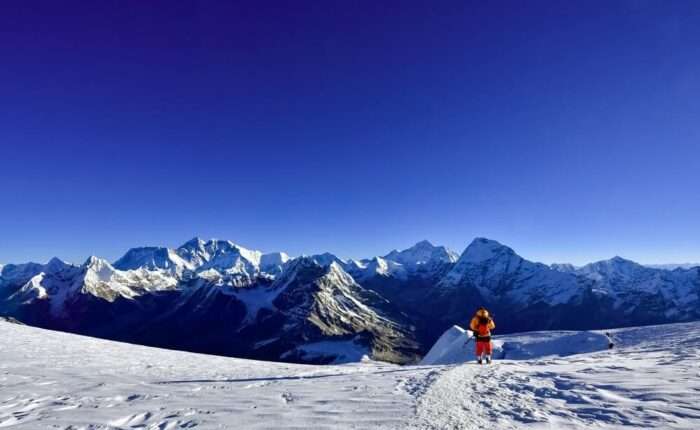
The Island Peak Climbing of Nepal, also known as Imja Tse, is a popular trekking peak in the Everest region. Sitting in the heart of the Khumbu region within Sagarmatha National Park, Island Peak is a popular trekking peak for those looking to combine the thrill of Himalayan mountaineering with the beauty of the Everest Base Camp trekking route. This incredible journey not only offers stunning views but also takes you through the Everest three passes, showcasing some of the world’s most breathtaking landscapes.
The adventure starts in a lovely town called Lukla, which is like the door to the Himalayas. We follow a path that’s like the one for Everest Base Camp trekking route, where many people go. Along this way, we see amazing scenery, visit friendly Sherpa villages, and walk beside a rushing river. Along the way, you’ll acclimatize to the high altitudes, preparing your body for the challenge ahead. As you approach Island Peak Base Camp, the anticipation builds.
Reaching Island Peak Summit is a monumental achievement. The climb is challenging yet achievable for trekkers with some mountaineering experience. The panoramic view from the summit is nothing short of spectacular, with the world’s highest peaks surrounding you. It’s an experience that will stay with you forever.
While Island Peak Climbing offers an unforgettable adventure, it’s essential to consider the Island Peak climbing cost and plan your trip carefully. With the right preparation and determination, you can make your dream of reaching the Island Peak Summit a reality. So, pack your gear, lace up your boots, and get ready for an incredible Himalayan adventure in the Khumbu region!
Island Peak climbing permits are obtained through the Nepal Mountaineering Association (NMA). After booking a trip from our agency we take care of all necessary permits. As of 2023, the permit fee structure for peaks in the Everest region (which includes Island Peak) was as follows:
Spring Season (March, April, and May):
Autumn Season (September, October, and November):
Please note that these permit costs are subject to change, and it’s essential to check with the Nepal Mountaineering Association
The Best climbing seasons for Island Peak in Nepal are generally considered to be the spring season and the autumn season. Here are the details:
Spring Season: The spring season for Island Peak climbing typically spans from March to May. This period is popular among climbers due to stable weather conditions, relatively milder temperatures, and clearer skies. The peak climbing season coincides with the famous mountaineering season for Mount Everest, so there is usually a significant number of climbers in the region during this time.
Autumn Season: The autumn season for Island Peak climbing usually runs from September to November. It is another preferred season for climbing as the weather is generally stable, with moderate temperatures and clear views. The autumn season is also popular among trekkers, and the trails in the Everest region are often bustling with activity during this time.
While the spring and autumn seasons are considered the primary climbing periods, it’s important to note that Island Peak can be climbed throughout the year. However, other seasons, such as winter (December to February) and monsoon/summer (June to August), are less popular due to harsh weather conditions, increased risks, and less favorable climbing conditions.
When planning an Island Peak climb, it’s advisable to consider the weather, your climbing experience, and other factors to choose the most suitable season for your adventure. Additionally, it’s recommended to consult with our experienced climbing local guides who can provide more specific and up-to-date information based on the current conditions.
Climbing Island Peak is challenging but achievable for climbers with some experience. It’s not extremely technical, but you need to be comfortable with basic mountaineering skills and using equipment like crampons and ropes.
The altitude is high, so you must be prepared for the effects of reduced oxygen and potential altitude sickness. The route includes crossing a glacier, so you need to navigate icy and uneven terrain. The weather can be tough with strong winds and cold temperatures.
Physical fitness is important for handling the demands of trekking and climbing. It’s recommended to climb with a knowledgeable guide. We provide you with a knowledgeable Sherpa climbing guide for your safety and support throughout the journey.
Climbing Mera Peak and Island Peak are both challenging adventures but can be accomplished with the right preparation and experience. Mera Peak, located in the Everest region of Nepal, is the highest trekking peak in the country. It requires a good level of physical fitness and stamina as you ascend to an altitude of 6,476 meters (21,247 feet).
Island Peak, also in the Everest region, stands at an elevation of 6,189 meters (20,305 feet). It is considered a moderate technical climb that requires basic mountaineering skills.
Both peaks offer breathtaking views of the Himalayas and a sense of accomplishment. However, it’s important to acclimatize properly to the high altitude and take safety precautions. If you have the right mindset, training, and support, you can have an unforgettable and rewarding experience climbing both Mera Peak and Island Peak.
If you want to do Both Mera and Island peak climbing then contact with us and we will provide you all the necessary information.
A climbing guide for Island Peak is a knowledgeable and experienced professional who assists climbers in their ascent. They have expertise in navigating the route, ensuring safety, and providing guidance throughout the climb.
During the island peak climb, the guide will set a suitable pace, allowing for breaks and rest as needed. They will keep an eye on weather conditions and make informed decisions about the best timing for summit attempts. Safety is their top priority, so they will assess risks and provide guidance on navigating challenging sections.
We provide you with a friendly and experienced guide for your Island Peak climb to ensure a well-organized and safe expedition.
Nepal is a land of the enthralling Himalayas and kind people. Awe-inspiring aerial views of snowy peaks, lush green terrain, rivers, and more greet passengers as they arrive at Tribhuvan International Airport.
One of our officials will greet you outside the terminal building after you arrive at the airport. After that, you’ll be taken in a private vehicle to a pre-arranged hotel. A brief meeting about the trip and its agenda will be held. Register at the hotel and freshen up.
Overnight in Kathmandu.
Today we Prepare for our Trekking and climbing things like gears cloths and more
Overnight in Kathmandu.
The trip commences with a flight from Kathmandu to Lukla, which takes you across countless hills and valleys with lush terraces. Before starting the day’s walk, porters and equipment should be arranged in Lukla. Both climbing and descending paths lead to Phakding.
The trail ascends the Dudh Koshi River, passing through green towns and colorful mani walls. Keep traveling clockwise or to the right of mani walls and prayer flag poles because this is a Buddhist region. Phakding is a Sherpa settlement located near the foot of a hill that leads to Namche.
Overnight in Phakding.
Several steel suspension bridges wrapped in prayer flags line the road to Namche Bazaar. From the last bridge, it’s a two-hour climb up to Namche. Before leaving Monjo, stop by the Khumbu National Park Information Centre, where you can use a 3D model of the area to trace our itinerary.
On a clear day, you can view Everest for the first time from an overlook about halfway up the hill. You’ll have the afternoon after arriving in Namche to rest and buy for last-minute items.
Overnight in Namche Bazaar.
Namche Bazaar is a small highland town populated by Sherpas. At 3,440 meters above sea level, it is located in the Khumbu area. As the primary trading hub, it is the final stop with hotels, restaurants, ATMs, salons, and other amenities.
This day is for you to adjust your body to the high elevation and the surrounding temperature. On this day, it is a must to stay active to cope with the new surroundings. There are numerous options on how to spend the day. You can take a stroll or go on a short hike.n
On foot, you reach Everest View Point. This amazing ascent takes you to a vantage point where you can see the breathtaking Everest for the first time on the trip. Take in the beautiful Himalayan views and spend some time exploring the area before returning to Namche Bazaar.
Overnight in Namche Bazaar.
After a night in Namche Bazaar, you begin your trip. Due to the uneven landscapes and roads, the trail to Tengboche becomes more difficult.
The hike begins with a walk along the valley’s edge. The journey to Phungi Thenga is straightforward. However, as the journey progresses, it becomes more difficult. You can see Mt. Everest, Nuptse, Lhotse, and Ama Dablam from a continuous climb in the Khumbu region. And then you’ll arrive in Tengboche.
In the evening, you can visit a Buddhist monastery with panoramic views of the peaks in Tengboche.
Overnight in Tengboche.
The journey from Tengboche to Dingboche is wonderful. You’ll pass through and see snowy mountains on your way there.
After leaving the village, you travel past a forest on your way down to Deboche village. After a period of traveling, you’ll run over a stone-carved wall. After a brief climb, you enter the other side of the valley after traversing a suspension bridge. At this point, Ama Dablam can be seen up close. After the continuous hike, you arrive in Pangboche village and hike uphill past Shomare town. You’ll soon arrive in Dingboche.
Overnight in Dingboche.
Today is the second acclimatization day of the trek. Nangkartsang Peak is located just above Dingboche. So, the ascent to the peak will help you prepare for acclimatization.
Nangkartsang divides the valley in two. The Imja valley on the way to Chukkung is on one side, and the valley on the way to Lobuche is on the other. The hike has a high rise. As you trek towards the summit, the views of Lhotse, Makalu, Cho Oyu, Ama Dablam, and other peaks are spellbinding. Nangkartsang Peak will be reached in no time. From the peak, take in the captivating mountain views. You’ll soon be on your way back to Dingboche on the same trail.
Overnight in Dingboche.
The trek from Dingboche to Chhukung is a relatively straightforward one. You may walk down the valley by the river after breakfast. The path is rocky, stony, and uneven.
Moving farther, you’ll be greeted with a stunning panorama of Lhotse and Nuptse. On the way, you’ll pass the Lhotse South Face Memorial. This was built in honor of those who died while attempting to reach the peak.
You finally arrive in Chhukung. Among the communities on your walk, it is one of the smallest. There are only a few teahouses in this area.
You reach Chhukung before lunch time so this day is a rest day if you want you can hike Chhukung-ri.
Overnight in Chhukung.
The hike to Island Peak Base Camp is a steep ascent. The ride to base camp will be fantastic, with breathtaking vistas of the Himalayas and glaciers.
You’ll get to practice for a pre-climb attempt today. To begin, you’ll get the opportunity to practice rappelling and belaying skills with pros. There will also be illustrations of how to use ice axes, ascenders, harnesses, karabiners, and other climbing equipment.
After breakfast, you’ll set out for a steep climb outside of Chhukung. The trail takes you past the glaciers of Lhotse and Imja. On the trip, the panoramic vistas of peaks are breathtaking. After a quick hike, you’ll arrive at Island Peak Base Camp. This is where you attempt to reach the summit. Two person for 1 tent will be pitched and waiting for you when you arrive at base camp. Overnight in Island Peak Base Camp.
The climb to the peak of the Peak should begin as soon as possible. Because clouds and strong winds will be an issue in the afternoon, the team will begin the ascent after midnight. Because the climb to the summit takes a full day, you should bring a packed lunch.
High Camp will be reached if you go on. After ascending to Crampon Point, the terrain becomes snowy and slick. As a result, you’ll need to put on your crampons. For the safety of ascending 5,700 meters farther, the team is hooked together by a man-rope.
After a long journey along a narrow ridge, the Imja Glacier’s base is reached. Various peaks from the glacier, such as Makalu, Baruntse, Mera, and others, dazzle your eyes with their breathtaking beauty. A massive vista of Lhotse appears as you approach the peak of Island Peak.
Climbing a vertical wall is the most difficult component of the climb at this point. The peak is reached by climbing up a wall using anchors and following a fixed line. You’ll need to use ladders to traverse one or two crevasses during the process. Finally, you’ve reached the pinnacle. Take advantage of your time at the summit. Take a look at the beautiful scenery.
Later, return to the Basecamp. The trail back to the camp is a long downhill, so keep your eyes peeled. After you’ve arrived at Base Camp, take a break. The occasion necessitates a celebration of your accomplishment. Enjoy and rejoice.
After back from base camp we moved down to Chhukung
Overnight at Chhukung Village.
Pangboche is reached via a long descent. The return journey is straightforward. Enjoy the walk while taking in the amazing scenery and living in the moment.
Pangboche is a charming hamlet with a historic monastery. The Sherpa community has made their home here. Interact with the residents of the hamlet. Return to your bed and prepare for the next day.
Overnight in Pangboche.
The journey is drawing to a close. You’ll be up for a hike downwards. You will now leave Pangboche village and travel down to Namche Bazaar.
You climb downhill on a less technical trail, taking in the same breathtaking scenery. After passing through various villages like Deboche, Tengboche, and others, you arrive at Namche Bazaar. You’ll pass through several forests, rivers, suspension bridges, and other sights along the way.
Finally, you may relax and appreciate the creature luxuries that you had to forego for the peak. Visit restaurants, cafés, bakeries, and other similar establishments to enjoy the coffee and delicacies that you’ve been yearning for.
Overnight in Namche Bazaar.
After checking out of the lodge and eating a substantial breakfast, you’ll make your journey down to Lukla.
Returning to the rocky and steep paths, you pass under suspension bridges and walk alongside the Dudh Koshi River. As a result, you’ll have to climb a difficult hill to get to Lukla.
For the final time, you can celebrate your achievement with Sherpa guides and porters in Lukla.
Overnight in Lukla.
Early the next morning, you’ll travel back to Kathmandu. Take the flight back to civilization and bid farewell to the peaceful and beautiful mountains. In Kathmandu, the rest of the afternoon will be free. Walking through the streets of Kathmandu, shopping for mementos, having a massage, or chilling at the hotel are all enjoyable activities.
Overnight in Kathmandu.
Today is the concluding day of your Nepal journey. Approximately 3 hours before your scheduled flight, a representative from Nepal Mountain Adventure will transport you to the airport. You’ll have plenty of time on the way home to plan your future excursion to Nepal’s beautiful country.
Island Peak climbing with Nepal Mountain Adventure starts from USD 1,799 per person including the peak climbing permit, base camp to summit guide, camping equipment, all meals at base camp, Lukla flights, and the full Everest Base Camp Trek approach itinerary to reach the mountain.
The complete Island Peak climbing package takes 18 to 21 days with Nepal Mountain Adventure including the standard EBC trek approach to Island Peak Base Camp, a dedicated pre-summit training day on the glacier, and the summit push to 6,189 m before descending and returning to Lukla for the flight to Kathmandu.
Island Peak (Imja Tse) at 6,189 m is rated as a moderate to strenuous trekking peak with technical sections requiring fixed rope ascending, crampon use on the 50-degree snow and ice face below the summit ridge. Prior experience with crampons and basic mountaineering movement is strongly recommended though dedicated beginners with good fitness can succeed with proper preparation.
With experienced guides and proper acclimatization through the EBC approach the Island Peak summit success rate is approximately 60 to 70% depending on weather conditions. Nepal Mountain Adventure’s experienced high altitude guides give trekking peak climbers one of the best summit success rates of any operator on the Khumbu standard peaks.
Two specific permits are required which are the Island Peak Climbing Permit (USD 250 per person in spring, USD 125 in autumn) issued by the Nepal Mountaineering Association, and the standard Sagarmatha National Park Entry Permit (USD 30). Nepal Mountain Adventure handles all permit applications and NMA liaison officer registration before departure.
Spring (April to May) and autumn (October to November) are the two main climbing seasons. Spring is preferred as the EBC approach is at its most spectacular with Everest expedition activity visible at base camp. October offers stable post-monsoon conditions on the summit face. Nepal Mountain Adventure recommends booking at least 3 months in advance for spring departures.
Nepal Mountain Adventure provides crampons, ice axes, harnesses, carabiners, fixed ropes, and headlamps for all Island Peak summit bids. Trekkers should bring their own mountaineering boots rated for at least minus 20 degrees and personal high altitude clothing layers. See NMA’s detailed packing list for the complete gear checklist.
Yes and this is actually the standard approach. The Island Peak with EBC Trek combines the full 15-day Everest Base Camp route with the Island Peak summit attempt in one complete 21-day package. The EBC approach provides ideal natural acclimatization for the Island Peak summit day.
The summit of Island Peak (Imja Tse) reaches 6,189 m making it the highest summit achievable by non-technical trekking peak climbers in the Khumbu region. From the summit trekkers get a 360-degree panorama of Lhotse (8,516 m), Makalu (8,485 m), Baruntse (7,129 m), and Ama Dablam (6,812 m) surrounding them on all sides.
Island Peak Base Camp sits at approximately 5,087 m and Nepal Mountain Adventure sets up a full service base camp with expedition tents, dining tent with cooked meals, sleeping bags rated to extreme cold, a base camp cook, and a pre-summit training session on crampons and fixed rope technique on the lower glacier before the summit attempt day.
| Cookie | Duration | Description |
|---|---|---|
| cookielawinfo-checkbox-analytics | 11 months | This cookie is set by GDPR Cookie Consent plugin. The cookie is used to store the user consent for the cookies in the category "Analytics". |
| cookielawinfo-checkbox-functional | 11 months | The cookie is set by GDPR cookie consent to record the user consent for the cookies in the category "Functional". |
| cookielawinfo-checkbox-necessary | 11 months | This cookie is set by GDPR Cookie Consent plugin. The cookies is used to store the user consent for the cookies in the category "Necessary". |
| cookielawinfo-checkbox-others | 11 months | This cookie is set by GDPR Cookie Consent plugin. The cookie is used to store the user consent for the cookies in the category "Other. |
| cookielawinfo-checkbox-performance | 11 months | This cookie is set by GDPR Cookie Consent plugin. The cookie is used to store the user consent for the cookies in the category "Performance". |
| viewed_cookie_policy | 11 months | The cookie is set by the GDPR Cookie Consent plugin and is used to store whether or not user has consented to the use of cookies. It does not store any personal data. |